On Telling and Not Telling Our Full Story
In Part 1, we spoke of the Passover Haggadah’s two origin stories. One, in accordance with Shmuel, focuses on the slavery Pharaoh imposed upon us in Egypt—its costs and its legacy. The other, in accordance with Rav, focuses more on our beginnings as idolaters.
That second story leads us back to Abraham, who was an idolater.
Abraham does respond to G!d’s call, and forges a new spiritual path—the Israelite religion that will become Judaism. But the beginnings of this new religion include slavery.
As we noted, immediately after heeding G!d’s call, we read:
וַיִּקַּ֣ח אַבְרָם֩ אֶת־שָׂרַ֨י אִשְׁתּ֜וֹ וְאֶת־ל֣וֹט בֶּן־אָחִ֗יו וְאֶת־כׇּל־רְכוּשָׁם֙ אֲשֶׁ֣ר רָכָ֔שׁו
וְאֶת־הַנֶּ֖פֶשׁ אֲשֶׁר־עָשׂ֣וּ בְחָרָ֑ן וַיֵּצְא֗וּ לָלֶ֙כֶת֙ אַ֣רְצָה כְּנַ֔עַן וַיָּבֹ֖אוּ אַ֥רְצָה כְּנָֽעַן
Abram took his wife Sarai and his brother’s son Lot, and all the wealth that they had amassed, and the living things that they had made in Haran; and they set out for the land of Canaan.
What sounds awkward here is the phrase more literally rendered as “the living things that they had made in Haran.” The Hebrew uses the verb asa, “made,” which in TanakhAn acronym for the name of the Hebrew Bible: Torah, Neviim, and Ketuvim. Read more sometimes means “acquired” when speaking of property. Thus, Rashi accurately translates the word “made” as kanah, “bought.”
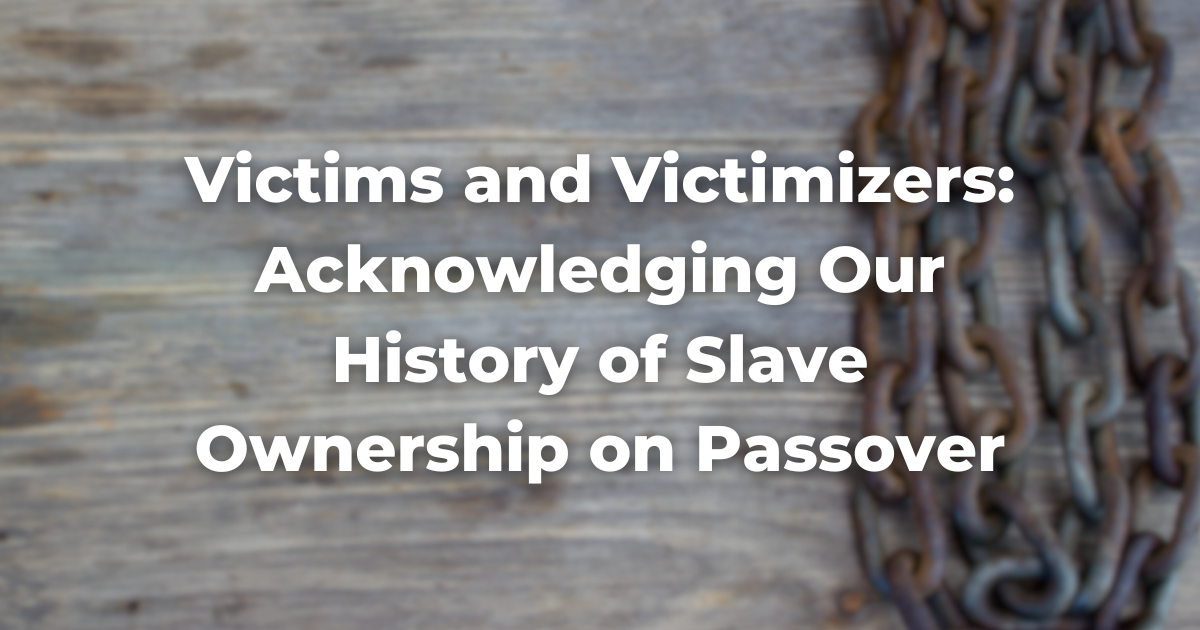
The phrase “living things” (nefesh) are people, whom Abraham “acquired.” So, Abraham bought human property. These are slaves. Abraham and Sarah brought slaves into the holy space of the land of Israel as they began a new religious path, under God.
This is stunning.
Thinking about slave ownership as part of our people’s beginnings, we should all feel humbled. Rav’s origin story, then, points out our role as oppressors. In this, it mirrors America’s minority 1619 narrative, which highlights slave ownership in the beginnings of the American story.
We don’t know where Abraham’s slaves are from, nor their cultures and faith traditions. Moreover, as a point of fact, the text does not even call them anashim, “people,” or b’nei adam, “human beings,” but nefashot, “living things.” The first four times that term appears in Tanakh, it refers to animals (Genesis 1:20, 1:21, 1:24, 1:30). The use of nefashot suggests that we should think of slaves as less than human.
Moreover, these slaves do not appear in the list of people that Abraham took with him. Rather, they appear after the list of wealth that Abraham and Sarah acquired. This suggests that human slaves, called “living things,” were valued less than material things.
A midrash further tells us not that the slaves willingly converted to Judaism, but that Abraham and Sarah converted them. This effectively deprived them of their native culture and faith, and even of their names.
Abraham’s slaves, like most American slaves, no longer have their own names, their own culture, their native faiths. They live as property, without the kind of lives, faith, and culture we associate with free people.
As Jews, we must ask: Where is G!d’s outrage that Abraham would think that taking along slaves, rather than freeing them, was a kosher way to start a new spiritually grounded endeavor? Where is the rabbinic tale depicting Abraham and G!d arguing over this? Where are the midrashimThis word is used in two ways, as both a concept and a literature. As a concept, midrash is the expansive interpretation of biblical texts. The term is used to describe the practice of rabbinic interpretation. As a text, it refers to specific collections of interpretations, particularly from the third to ninth centuries in the Land of Israel and Babylonia. Plural: Midrashim
Read more that give these slaves their humanity? Where are the tales that fill out their lives, their names, their cultures, their dignity, their worth?
After the Exodus and the Ten Commandments are received, the very first laws that are promulgated for us as a people, laws presented as given on Mount Sinai, concern how we shall maintain slavery as an institution. And maintain slavery throughout our history, we did—including in the American South. So, for example, Jewish Heritage North Carolina reports that in 1830, some 83% of Jews in Charleston owned slaves.
Whatever qualities Abraham possessed that qualified him for starting this new, Godly venture, it is fascinating that virtually the only thing the TorahRefers to the first five books of the Hebrew Bible, the Tanakh, also called the Five Books of Moses, Pentateuch or the Hebrew equivalent, Humash. This is also called the Written Torah. The term may also refer to teachings that expound on Jewish tradition. Read more informs us about Abraham at the time he began this new spiritual endeavor in the world and for the world was that he owned slaves. And it is the one thing he took with him from his previous life and culture to start a new religious culture in Canaan.
Thus, at the moment of our beginnings with G!d, owning slaves was permitted and held up by our foundational text, the Torah.
So at our seder we tell two origin stories, each of which charts a journey from “disgrace” to “praise.” One, Shmuel’s focus, tells of our powerlessness and victimhood by others; the other, centered by Rav, of our power over and victimizing of others. Most of us only sing Avadim Hayinu, and that story of victimization resonates for many of us and what we have been taught about Jewish history. Yet that, the Haggadah suggests, is an incomplete rendering, a partial truth. And only telling a partial truth distorts the fullness of Jewish history and Jewish experience. In fact, we don’t even have a song for—and often skip—Mit’hilah.
But the Haggadah asks us not to gloss over our history of victimizing and even enslaving, but to sit with it. That is part of Jewish history and experience as well. That is something from which we need liberation, too.
Rather, the Haggadah invites us to consider both stories and how we might integrate them in a new telling, one that offers us a way forward, where we don’t just ignore the misdeeds of our past, or acquiesce in them, but one that incorporates both stories and reshapes our culture, so that we move each other towards a place and time where all life, all people/s, are free, beloved, and holy. That would indeed move us from “disgrace” to “praise.”
Starting this year, may the story we tell be one that honors truth and justice, for those are the ways of peace.