
My grandmother’s youth in a Jewish home reflected the traditions of a close-knit family. She grew up as a Conservative Jew in Queens, New York, meaning that she and her family lived in observance of Jewish law. Her family practiced strict Kashrut, observed Shabbat, and celebrated all the Jewish holidays. She saw “conservative” just as her family’s lifestyle; men and women sat together in shul and incorporated Jewish practice into their lives each day. Her family’s Judaism revolved around Shabbat, kashrut, and holidays. Every Friday night she remembers getting everything ready for the evening meal, and her family would even take the light bulbs out of their refrigerator to avoid breaking Shabbat.
The requirement to eat kosher food was non-negotiable and particularly relevant, because when she would go to Costa Rica—a country that was approximately 97% Catholic and where her own mother was raised—to visit her extended family who lived there, the only synagogue was an Orthodox shul. The women were seated upstairs and the men were downstairs and since there were no kitchen facilities in the synagogue, everyone brought in their own food. Kosher meat was in short supply in Costa Rica, so when traveling abroad, her family would fill their suitcases with kosher foods to bring back home. A single shochet was available for all of Central America, so her family often went weeks without fresh meat and eventually raised their own chickens until it was time to see the butcher.
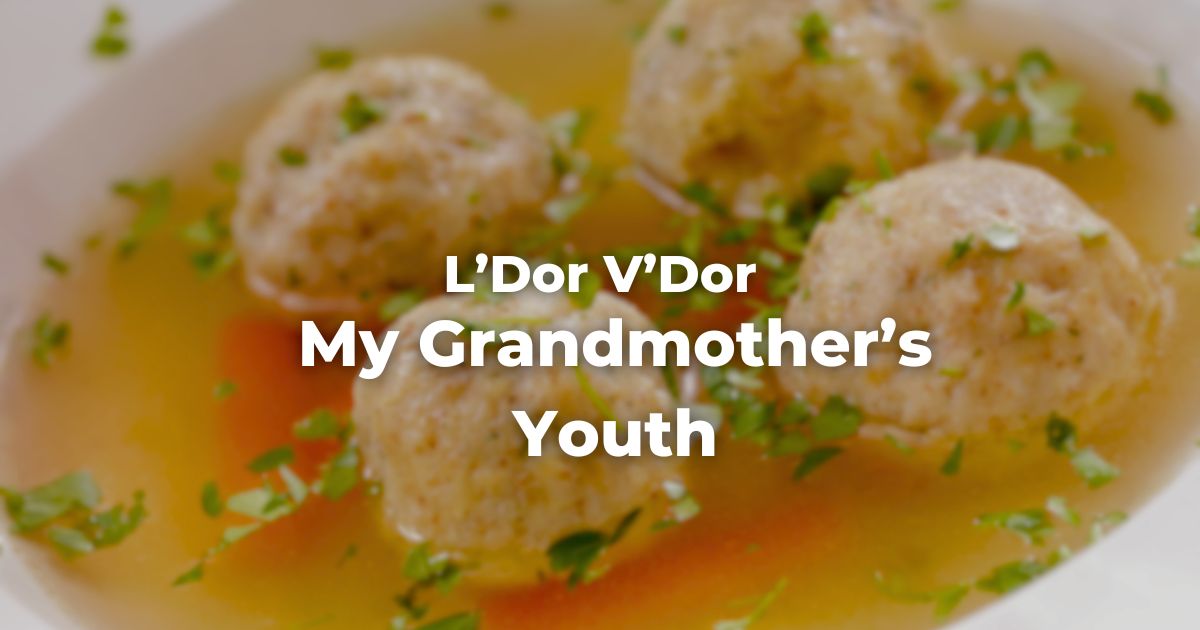
Food was a meaningful way to express Jewish identity in my grandmother’s family. She did not attend Yeshiva like her brothers, because her parents believed that a woman’s education was in the kitchen. She grew up with traditional Ashkenazi cuisine, including kneidlach, kreplach, kugel, tzimmes, borscht, and strudel. In addition to these dishes, she also learned how to cook Costa Rican foods such as plátanos, and how to incorporate pineapple and avocado into many different dishes. Her mother taught her to cook and the kitchen served as an ideal setting for learning about Jewish customs and religious education. Her parents believed that in order for a Jewish woman to know her heritage, she would best learn through practice. I’d say that practice makes perfect, since she makes the very best matzah balls! And she takes pride in making them, especially for Pesach.
Food and family traditions were equally important in forming her Jewish identity, and Shabbat was the highlight of her week. This was the only time when everyone in her family could get together and attendance was strictly enforced by her grandfather’s well-known saying of “If you don’t show up for Shabbat dinner, you’d better be dead!”
Havdalah also had personal significance to her, as she held up the candle above her head every week, hoping that she would end up with a tall husband. She now laughs about it, because she’s been happily married for many years to a man who is 6 feet 2 inches tall.
The story of her family begins with their incredible history of migration and survival. My great-great-grandfather, Mendel Steinberg, escaped Poland in 1929 when he recognized the threat of the pogroms. After being rejected by many countries, he and six other men arrived in Costa Rica, first as peddlers then finding success as business owners. They were instrumental in the establishment of a thriving Jewish community by bringing relatives and Holocaust survivors to safety and providing them with homes and jobs.
One of my grandmother’s favorite family tales is of my great-great-grandfather raising funds for the state of Israel and travelling to Brooklyn, where a rebbe helped arrange a marriage, between an American soldier (the Rebbe’s nephew) and a pretty young Costa Rican Jewess (my great-grandmother) which would later be remembered fondly as “a match made in the Rebbe’s study.”
Her family has passed down many Judaica items, everything from candlesticks to tefillin. They are lovingly handed down from generation to generation and are filled with memories from the past. As my grandmother observes, she is grateful that her daughters have married Jewish men and created their own Jewish homes, continuing the traditions that characterized her life. The stories my grandmother tells illustrate that Jewish identity is deeply rooted in family, rituals, and community, and these components have served as the foundation of her remarkable life.
This essay was submitted as part of Exploring Judaism’s L’Dor V’Dor Essay Contest. To learn more, or submit your own essay, go here.