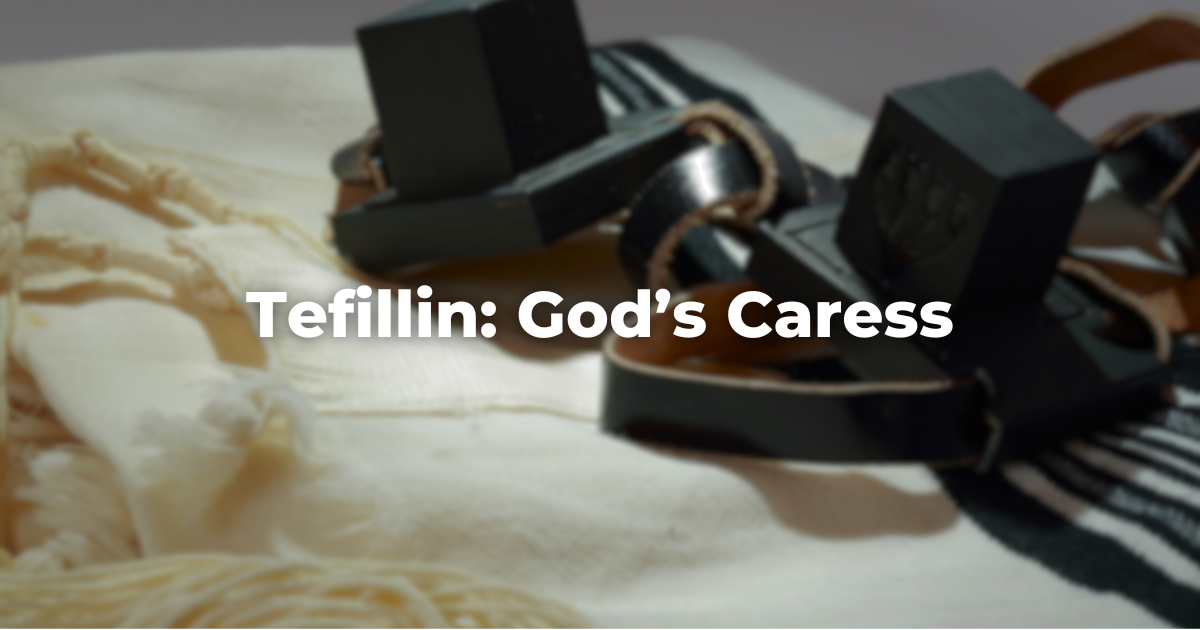

When you lay tefillin, your hands are no longer free. You embody the mitzvah: straps are bound to your skin, parchment is pressed close to your brain, your fingers are weighed down by leather. Laying tefillin forces you to feel held back—and held.
God’s Tefillin
One of the most striking midrashim of the TalmudReferring to one of two collections, the Jerusalem and Babylonian Talmuds, edited in the 6th century, that contains hundreds of years of commentary, discussion, and exploration of the ideas in the Mishnah. One could describe it as Mishnah + Gemara = Talmud Read more, in masekhet Berakhot (6a), pushes this embodiedness beyond its limit.
אָמַר רַבִּי אָבִין בַּר רַב אַדָּא, אָמַר רַבִּי יִצְחָק: מִנַּיִן שֶׁהַקָּדוֹשׁ בָּרוּךְ הוּא מַנִּיחַ תְּפִילִּין שֶׁנֶּאֱמַר: ״נִשְׁבַּע ה׳ בִּימִינוֹ וּבִזְרוֹעַ עֻזּוֹ״.
Rabbi Avin bar Rav Adda said that Rabbi Yitzḥak said: From where is it derived that the Holy One wears phylacteries? As it is stated: “The Lord has sworn by His right hand, and by the arm of His strength” (Isaiah 62:8).
״בִּימִינוֹ״ — זוֹ תּוֹרָה, שֶׁנֶּאֱמַר: ״מִימִינוֹ אֵשׁ דָּת לָמוֹ״, ״וּבִזְרוֹעַ עֻזּוֹ״ — אֵלּוּ תְּפִילִּין, שֶׁנֶּאֱמַר: ״ה׳ עֹז לְעַמּוֹ יִתֵּן״.
Specifically, “His right hand” refers to the TorahRefers to the first five books of the Hebrew Bible, the Tanakh, also called the Five Books of Moses, Pentateuch or the Hebrew equivalent, Humash. This is also called the Written Torah. The term may also refer to teachings that expound on Jewish tradition. Read more, as it is stated in describing the giving of the Torah: “From His right hand, a fiery law for His people” (Deuteronomy 33:2). “The arm of His strength,” His left hand, refers to tefillin, as it is stated: “The Lord gave strength to His nation” (Psalms 29:11), in the form of the mitzvah of tefillin.
To contemporary ears, this is almost blasphemous. God wearing tefillin?! It is disturbing not only because of the corporal presupposition the midrash—that God might have a body—but also because of its fundamental theological paradox. God, a being we consider to be infinite, perfect and therefore self-sufficient—praying?!
And not just praying—praying in the very way that anchors our spiritual demands in the material realm: with tefillin.
Does God, like us, need to anchor the spiritual into the material?
Through the parchment contained in their boxes, tefillin serve to remind us of the covenant with God. But does God need to be reminded of God’s Torah?
To understand what the sages are saying about God in this midrashThis word is used in two ways, as both a concept and a literature. As a concept, midrash is the expansive interpretation of biblical texts. The term is used to describe the practice of rabbinic interpretation. As a text, it refers to specific collections of interpretations, particularly from the third to ninth centuries in the Land of Israel and Babylonia. Plural: Midrashim
Read more,
Let us rethink what tefillin symbolize.
I want to suggest that tefillin’s ultimate power lies more in what they prevent than what they enable.
In her commentary on Parashat Treruma, Aviva Gottlib Zornberg analyzes the different roles that Moshe’s hands played in the history of the Exodus:
It is his hand … grasping the staff, that has brought plagues down upon the Egyptians, that has charged the Red Sea to split apart. … Moses holds his hands in the air and mysteriously conducts the fortunes of war in the battle against Amalek. In that enigmatic scene Moses instruct Joshua to lead the Israelites forces, for “tomorrow I shall station myself on the top of the hill with the staff of God in my hand” (Shemot 17:9). When, however Moses is described at the top of the hill, there is no mention of the staff:
“Whenever Moses held up his hand, Israel prevailed; but whenever he let down his hand, Amalek prevailed” (17:11)
The Ramban explains that Moshe’s hands are nessiat kapayim, perisat kapayim—the classic gesture of hands outspread in prayer. The hand that prays is a disarmed one.
And necessarily so, because, by their very nature, tefillin prevent us from holding—an impediment I can testify to daily, as I try and fail to turn the page of my siddur, or, dare I confess, grab my phone…
The tefillin’s purpose is to prevent us from grasping. They instill in us the value of empty-handedness. Grasping is a double entendre: to hold physically, and to comprehend. Tefillin teach us that prayer is the acceptance of our limitation in grasping, both physically and intellectually, when standing in front of the divine. Prayer springs from a place of lack.
Moshe’s military triumph came through the emptiness of his hands. His final enigmatic failure also comes from his hands. When he hits the rock (Numbers 20), in the words of Aviva Gottlib Zornberg, this represents “a regressive return to the staff modality.” He hits the rock instead of speaking to it; his hands return to grasping.
Tefillin do not allow us to grasp. Rather, we are the ones being grasped by them, as they lovingly wrap themselves around our arms.
But their ultimate significance might be expressed precisely when they are no longer there.
When all that is left of the tefillin is that space impressed in our skin,
“marking the memory of [ their ] absence, something precisely not grasped,” we face the true nature of our relation to God. The trace of God on our arm—on our heart, according to the midrash, for the tefillin shel yad is precisely the one that fulfills the commandment “al levavekha,” upon the heart—appears and fades away. At first a trench on our skin, then a mere presence only noticeable to those who seek it, before its disappearance—before God’s eclipse.
We all, individually and as a people, have experienced those different manifestations—and lack thereof—of God. Both our skin and our history testify to God’s presence, and bear the mark, the scar, of God’s absence.
In parashat Yitro, we learn that the tablets of the covenant were carved in stone, harut al halukhot. As opposed to the process of writing on paper, which requires adding ink to the surface, engraving requires subtracting—carving out. The meaning is embedded into the emptiness. Laying tefillin is our daily re-enactment of that process, building into our own skin the testimony of the covenant laid out in the tablet.
Tzaar Gidulei Banim
A final midrash, in masekhet Shabbat (66b), speaks of צער גידולי בנים, the pain of raising children.
We are told that children would be allowed to go on streets, on Shabbat, wearing some enigmatic knot:
אלא מאי קשרים כי הא דאמר אבין בר הונא אמר רבי חמא בר גוריא בן שיש געגועין על אביו נוטל רצועה ממנעל של ימין וקושר לו בשמאלו אמר רב נחמן בר יצחק וסימניך תפילין
Rather, what are these knots? Like that which Avin bar Huna said that Rav Ḥama bar Gurya said: A son who has longings for his father and has a difficult time leaving him, the father takes a strap from the right shoe and ties it on the boy’s left. Rav Naḥman bar Yitzḥak said: And your mnemonic for phylacteries…
In this midrash, tefillin—or what stands as their mnemonic—no longer remind us of our relationship, but rather the opposite. They teach us the possibility of fission. If Judaism is (as Levinas claims) a religion for adults, the fusion relation to the parent needs to be outgrown. Like a loving yet distant parent, God has tied on our arm the knot for us to grow beyond our need for constant connection to God.