
We tend to believe that latkes and sufganiyot have been on the Jewish table for centuries. But that notion is far removed from historical facts. Various recipes have represented Hanukkah’s culinary traditions, with many focusing on deep-fried foods. This commemorates the miracle of the oil—and makes for an appealing choice during winter months. So, when and why did we start enjoying these savory and sweet delicacies as a Hanukkah must?
The Journey of Latkes
Jews in Sicily were the first to make “latkes,” using ricotta, a classic white cheese from that region. The tradition of eating fried pancakes during Hanukkah began with the Sephardic Jews who settled there, inspired by medieval rabbinical teachings. They used olive oil to remember the miracle of the oil and included ricotta to honor the apocryphal heroine Judith, whose bravery in serving cheese and wine to her enemy mirrored the courage shown by the Maccabees. Our sages established this connection in the Middle Ages.
After the expulsion of the Sicilian Jewry in 1493 during the Inquisition, the recipe made its way to Rome. It then began spreading throughout Central and Northern Europe. As the recipe traveled north, access to white cheese and olive oil diminished. Ashkenazi communities adapted the recipe by substituting with local ingredients. They used schmalz (rendered goose or chicken fat) for frying and turnips, buckwheat, or rye as the main ingredient, as potatoes were not yet available in Europe.
The colonization of the Americas introduced potatoes to Europe, but it took several centuries to integrate them into local cuisine. During a famine in the 19th century, Jews began using potatoes, leading to the relatively new tradition of potato latkes.
Ashkenazi Jews’ arrival in North America allowed latkes to flourish. They became a quintessential Hanukkah dish, often served with sour cream or sweet applesauce. Today, there are numerous variations of the original recipe. Some experiment by adding colorful ingredients like beetroot, carrot, or green herbs.
Use of the Term “Latke”
Initially, Jews referred to latkes as potato pancakes or the German kartofelpuffer. We adopted the Yiddish term latke much more recently. It comes from the East Slavic word oladka, meaning “small fried pancake,” which itself comes from the Hellenistic Greek eládion, a diminutive of élaion, meaning oil.
The Sufganiyot Phenomenon
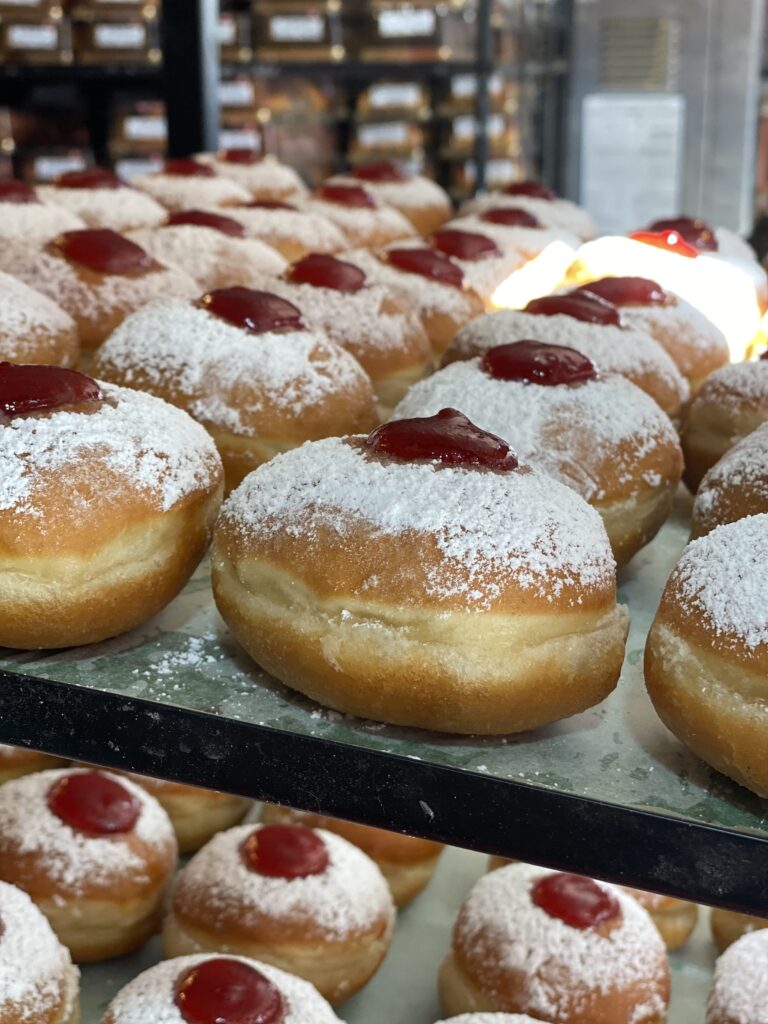
In Israel, the Hanukkah celebration is often more closely associated with sufganiyot, which have a complex history of cultural exchange. Middle Eastern cultures have several similar fried dough recipes, some adapted by Sephardic Jews (such as buñuelos). However, modern sufganiyot trace back to an old non-Jewish German delicacy. It was first mentioned in 1485 as gefullte krapfen (filled donuts) in the German cookbook Kuchenmeisterei. The original recipe called for two rounds of dough filled with jam, deep-fried in lard, which was later replaced by schmalz in the Jewish context.
Polish Jews referred to these donuts as ponchiks or ponchkes. They brought the recipe with them to Palestine during the early aliyah periods. In the 1920s, the Jewish labor federation in Israel recognized this recipe as an opportunity to support bakers. They declared sufganiyot the official Hanukkah food. While latkes remained a homemade specialty, sufganiyot emerged as a national trend. The name sufganiyot comes from the Hebrew sfog (sponge), referring to the dough’s sponginess and capacity to absorb oil.
Today, sufganiyot come in various sizes and fillings. While the classic strawberry jam remains popular, many new flavors are emerging in bakeries across Israel and beyond—from the ribat chalav introduced by Argentinian migrants in the 1980s to creative variations like Bamba and Pistachio Creme.
The success of the sufganiyot business clearly demonstrates the effectiveness of the marketing strategy employed by the Labor Union a century ago. Israeli bakeries have evolved into one of the most thriving and culturally diverse culinary scenes in the world, influencing Jewish bakers globally.
What Do Hanukkah Foods Say About Jewish Culinary History?
Jewish culinary history is dynamic and creative. Migration plays a significant role, drawing inspiration from tradition and legacy. Jewish cookbooks are open to innovation and change. New flavors and traditions are waiting to be explored in both the kitchen and at the table. We invite you to explore and be innovative, to contribute with your own twist to these two wonderful Hanukkah classics.