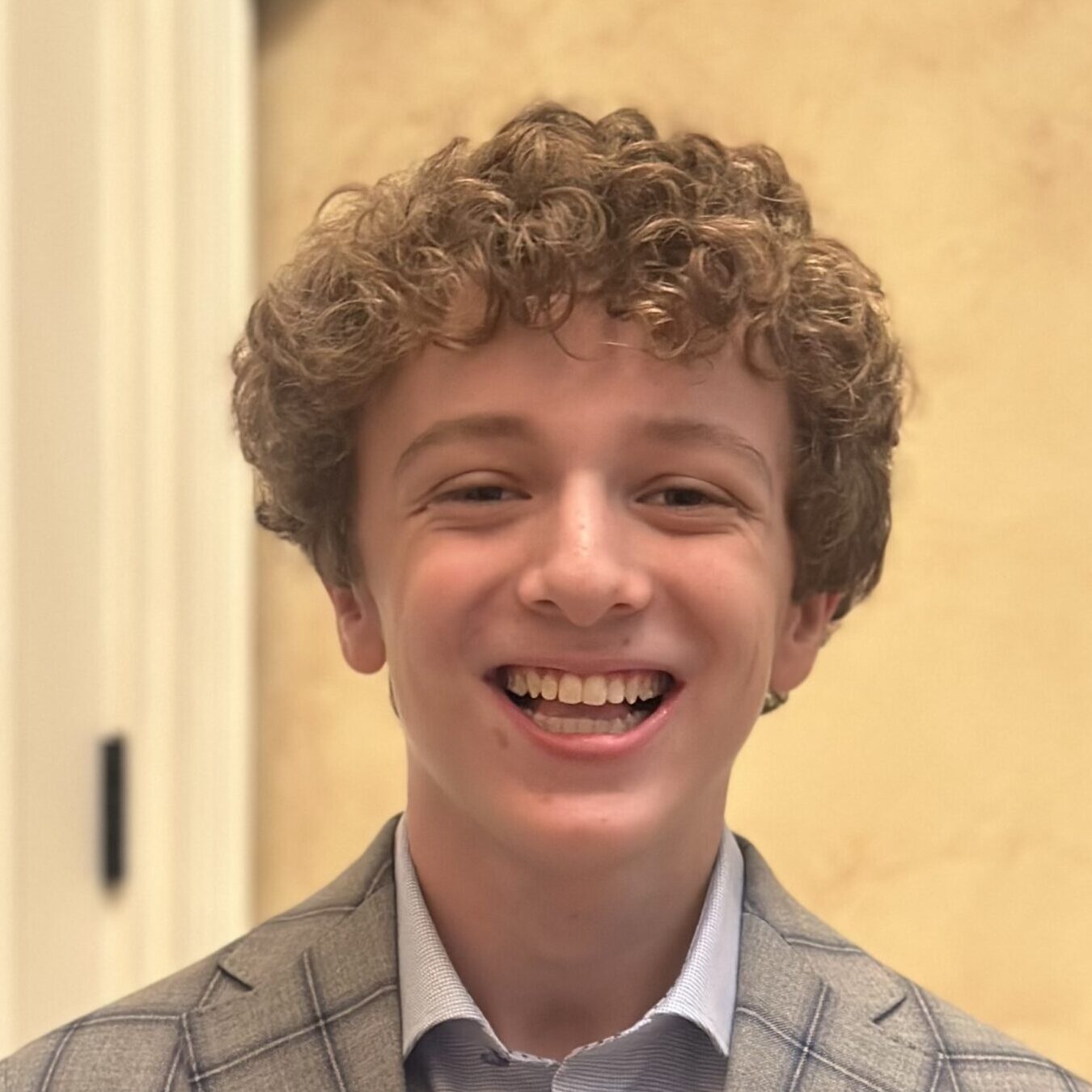
My name is Emerson Blum. I am a tenth grader from Chicago. All my life I have attended Conservative Jewish institutions, including Solomon Schechter Day School, Rochelle Zell Jewish High School, and Camp Ramah in Wisconsin. Thus, Conservative Judaism is the denomination I am most comfortable practicing.
As I prepared to speak to my grandparents, I hoped to understand how they developed their traditions and practices. Learning from them strengthened my desire to preserve and pass down the Conservative traditions that I acquired growing up.
My maternal grandparents, Nonnie and Harvey Shaffer, were born in the 1940s and raised in Montreal in a close, tight-knit Jewish community. My grandmother grew up attending a traditional Conservative synagogue without mixed seating or egalitarian services. Jack Fenster, my great-grandfather, was a pious man whose parents immigrated from Vienna. He laid tefillin daily, kept Shabbat and a kosher home, and would only eat kosher meat outside the house. My grandmother recalls finding missing silverware buried in plants years after his death—his way of “kashering” meat utensils accidentally used with dairy food or vice versa.
My grandparents pointed to egalitarianism as an example of a change in the character of Conservative Judaism. Today, most Conservative shuls invite women to read the TorahRefers to the first five books of the Hebrew Bible, the Tanakh, also called the Five Books of Moses, Pentateuch or the Hebrew equivalent, Humash. This is also called the Written Torah. The term may also refer to teachings that expound on Jewish tradition. Read more, lead services, count in a minyan, and there are many female Rabbis. In my grandparents’ time, this was rare. Women could not lead services or be part of a minyan, despite being permitted to read from the Torah. Organs and choirs were rarely seen in Conservative shuls, and, according to my grandparents, shul parking lots were usually closed on Shabbat to encourage congregants to walk to shul. Many Conservative Jews purchased homes near shuls for this reason. This was true for my Canadian grandparents, but is not the case today.
Harvey and Nonnie both feel that these shifts have changed the face of Conservative Judaism. They worry that the movement bends too far towards modernization, leading many Jews to the Reform and Orthodox movements. Personally, I believe in gender inclusivity in Conservative Judaism. However, I also worry about modernization. My grandparents’ reflections showed me the complexities of change—it can feel meaningful, but also disorienting or concerning.
My grandfather Harvey grew up attending an Orthodox synagogue, although today his practices are more in line with traditional Conservative Judaism. He believes in God, and felt it was his duty to send both his children to Jewish schools and summer camps. He raised his family in a kosher home and they walked to shul on the high holidays.
My mother recalls that in her childhood home, Passover began with “Bedikat Chametz” (the search for leavened bread). She has fond memories of holding the candle and feather as a child while my grandfather searched the home for chametz. This is a tradition that has been passed on to my sister and me, and one that I look forward to doing with my Grandpa Harvey every Pesach.
My paternal grandmother, Phyllis Blum, came from a different Jewish background. Growing up in the Bronx, she was not very affiliated with Judaism, never attending religious services or observing holidays. When she was twelve years old, she saw pictures of the Holocaust in the newspaper and discovered the atrocities that had been committed against other Jews like her. Then and there, she decided she wanted to marry a Jewish man and raise Jewish children.
She married my late grandfather, Julius Blum, a Hungarian survivor of Auschwitz and Mauthausen. Through HIAS (Hebrew Immigration Aid Society), my grandfather got a college scholarship in Georgia, and eventually moved to New York City, where he met Phyllis at a Jewish dance in the Catskills. They married and had three sons, including my father, Andrew (named for my grandfather’s brother, Andor, who perished in the camps). Eventually, they settled in mountainous Asheville, which reminded my grandfather of his hometown’s Carpathian Mountains.
During the 1950s and 60s, many Jews, having lived through times of great Jewish trauma, were afraid to reveal their Jewish identity, especially in the Deep South. For this reason, my grandmother decided to change the pronunciation of our last name from “Bloom” to “Bluhm,” hoping it would help the family assimilate.
My grandmother says she feels most connected to the community aspect of Judaism, and for this reason, she chose to live in a Jewish retirement home called Gidwitz, in Deerfield, IL, after her husband passed away. She loves Gidwitz because of the sense of community she discovered she craved when she was only twelve years old.
My grandmother says she views Orthodox Judaism as too rigid, given her upbringing. However, she feels that Reform Judaism disregards tradition. She sees Conservative Judaism as the perfect middle ground, and I agree with her. My grandparents’ values are an important part of my own Judaism. I think that traditional Conservative Judaism is perfect because I can simultaneously live an American, secular life, and a religious one.
When I was young, I did not care much for Judaism, but the year before my Bar Mitzvah, something changed. I attended weekly services with my family, enjoyed the community, the spirituality, and the peace I felt at shul. After that, my synagogue attendance waned. However, entering tenth grade after a full summer at Camp Ramah, the spark that had ignited in me years earlier returned.
Now, my grandparents’ strong connection to Judaism finally resonates with me. I have gained a deeper appreciation of who I am and where I come from, and hope to instill these values in my children. Like my grandfather, I now demonstrate my Jewish pride by wearing a Star of David publicly, and have taken on community leadership roles.
My family’s story and strong connection to Judaism is a perfect example of L’Dor V’Dor, as Jewish values and traditions have been passed down from my grandparents to my parents, and finally to me. Although all members of my family may view Judaism in different ways, we all have embraced it as an integral part of our identity.
This essay was submitted as part of Exploring Judaism’s L’Dor V’Dor Essay Contest. To learn more, or submit your own essay, go here.