
For me, Hanukkah is all about tradition. There’s nothing like getting together with family and friends in the darkest time of the year to remember the miracle of the oil. And what would Hanukkah be without latkes—crispy, fried, and oh-so-delicious? I can just imagine my ancestors in the Old Country, proud that their recipes have reached the Goldene Medina—where the streets are paved with easily accessible cooking oil and fresh produce.
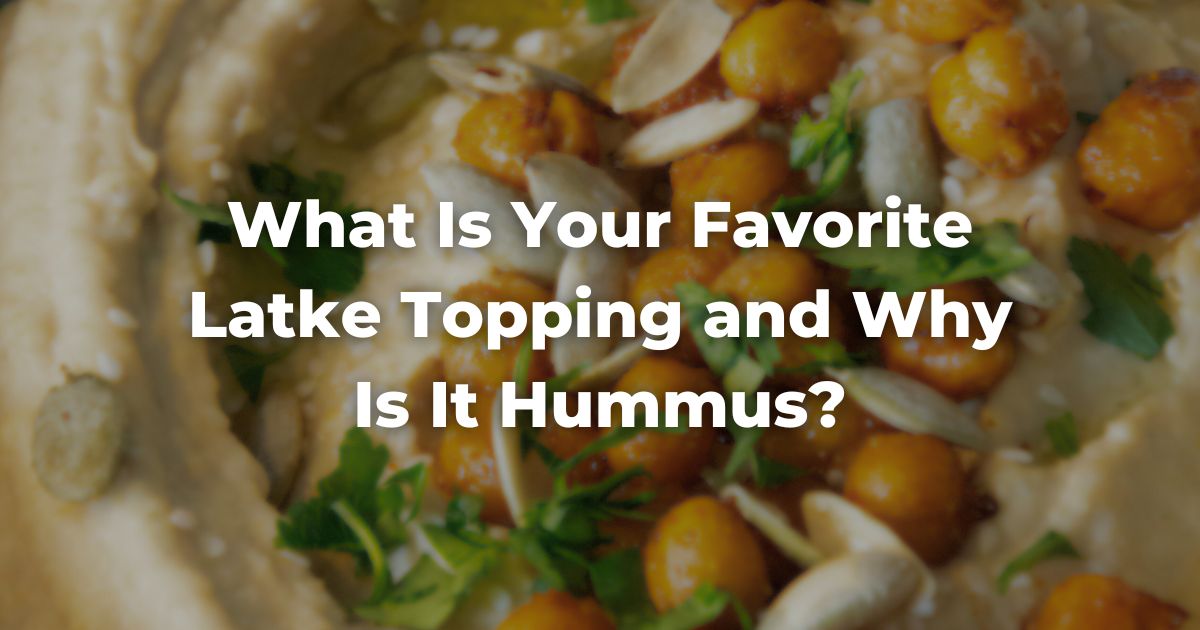
But, I’m sad to say, we live in a world of dreary latke toppings. Sour cream, applesauce, cream cheese—it’s all bubkes. It’s meaningless. It won’t elevate you to mystical union with the divine. In reality, there’s only one latke topping that allows us to truly appreciate the spiritual power of Hanukkah, and it’s hummus. Here are three reasons why:
#1: The Torah
The story of Hanukkah is, famously, not in the Bible—but chickpeas, which have long been a sacred Shabbat ingredient, feature prominently in the TorahRefers to the first five books of the Hebrew Bible, the Tanakh, also called the Five Books of Moses, Pentateuch or the Hebrew equivalent, Humash. This is also called the Written Torah. The term may also refer to teachings that expound on Jewish tradition. Read more. Just look at Genesis 6:11 with the Talmud’s commentary: “The school of Rabbi Yishmael taught: Don’t read chamas [the earth was full of wickedness], but rather chumus [the earth was full of hummus] (Sanhedrin 57a).” The TalmudReferring to one of two collections, the Jerusalem and Babylonian Talmuds, edited in the 6th century, that contains hundreds of years of commentary, discussion, and exploration of the ideas in the Mishnah. One could describe it as Mishnah + Gemara = Talmud Read more then adds, citing Genesis 6:12 with a parallel to Deuteronomy 4:16, that corruption of the world was due to idol worship. That means God destroyed the world because there was idol worship of hummus! Talk about an endorsement. The intense power of chickpeas must be used for only the highest spiritual purposes, by which I mean fried potatoes.
#2: Jewish Mysticism
Hanukkah, which commemorates the rededication of the Temple, became a symbol of renewal and t’shuvah in Hassidut, as the end to the High Holiday season. And chickpeas perfectly encapsulate this spiritual focus: each chickpea is round, like the kabbalistic Ein Sof. Chickpeas even have k’lippot, husks, which in kabbalah represent the distractions from mystical unity with God. When we remove the skins of our chickpeas, we become ever closer to the light of the Divine Presence that brings us close together in the darkest time of the year.
#3: Uniting the Spiritual and Historical
Look, when chocolate hummus became widely available in 2018, I was as skeptical as the rest. It seemed like a sacrilege—blasphemy, even. But what if, all along, chocolate hummus was just gelt-flavored? All these years, we had no way to combine latkes and gelt, the two most iconic Hanukkah foods. Latkes represent the miracle of the oil; and gelt represents the military victory over the Greeks. By bringing together these two reasons why we celebrate the holiday in one food pairing, we not only bring together the spiritual and historical significance of Hanukkah, but we redeem dessert hummus from its ignominious origins. It’s basically tikkun olam!
So, no matter how you spell Hanukkah, join me this year in honoring our hallowed texts and traditions. Do the right thing and have your latkes with holiness… I mean, hummus.