Every rabbi has a rabbi—someone who shaped them into the leader they became. For many North American Conservative rabbis, that figure is often Abraham Joshua Heschel. Rabbi Heschel’s radical prophetic activism continues to form their theology and moral character. In Latin America it is Rabbi Marshall Meyer. He was guided by that same fierce ethical commitment. He transformed the movement. Through the institutions he built and the example he modeled, he inspired generations of Latin American Jews.
This is the story of how Conservative Judaism arrived in Latin America. It’s the story of how one rabbi shaped the Judaism of not just my own family, but my whole continent.
Early Roots of Latin American Jewish Life
Latin American Jewry grew through major immigration waves between the late nineteenth and early twentieth centuries. It was fed as European Jews fled rising antisemitism, pogroms, and ultimately the Holocaust. Middle Eastern and North African Jews escaped growing hostility in their countries.
Communities developed across the region. But Buenos Aires, thanks to its important port and rapid urban development, became the main entry point. It evolved into the largest and most influential Jewish center in Latin America.
The Beginning of Conservative Judaism in Latin America
The development of Conservative Judaism in the region truly begins in the United States, with the ordination of Rabbi Marshall Meyer.
Raised in Connecticut, Meyer studied at Dartmouth and then at the Jewish Theological Seminary. At JTS, he formed a deep student-teacher relationship with Rabbi Abraham Joshua Heschel. Inspired by Heschel’s vision of a morally engaged Judaism, Meyer dedicated his life to grounding Jewish life in ethical responsibility.
In 1959, Marshall and his wife, Neomi, moved to South America. They hoped to help strengthen the Jewish community, despite knowing little Spanish. What began as a two-year commitment became twenty-four. According to legend, he chose Buenos Aires over Rio de Janeiro simply because it had more opera concerts.
Building Institutions and a New Vision
Upon arriving, Rabbi Meyer found a community wrestling with assimilation and disengagement. He focused on three core areas:
- Empowering youth.
He founded a Latin American Camp Ramah, to create a strong Jewish entry point for children and teens. He modeled it on the successful program in the United States. - Making learning accessible.
He translated and published classical and modern Jewish texts so people could learn in their native Spanish. - Reinvigorating synagogue life.
He introduced sermons in Spanish, instituted mixed seating, and championed the full inclusion of women in ritual practice.
After four years at Templo Libertad, his vision needed a broader platform. In 1963 he founded two institutions that would shape Latin American Conservative Judaism for generations
- Congregación Bet El.
- The Seminario Rabínico Latinoamericano.
Bet El became a model for a modern synagogue with rich programming and a vibrant youth movement. Yet the most enduring impact came from the creation of the Seminario.
Creating a Local Rabbinic Pipeline
Meyer understood that thriving Jewish communities need leaders who understand their people’s language, culture, and lived experiences. Latin America needed its own rabbis.
Through the Seminario, he trained and empowered hundreds of young leaders who built and strengthened communities across the continent. Today, nearly every Conservative rabbi and synagogue in Latin America traces its roots back to the Seminario and Rabbi Meyer’s vision.
Among those who carried his legacy forward was my aunt, Rabbi Silvina Chemen. She later served at Bet El, the very synagogue he founded.
Moral Courage in Dark Times
The 1970s brought turmoil and fear to Argentina. Political conflict escalated into the 1976 military dictatorship. It was marked by censorship, persecution, antisemitism, kidnappings, and the disappearance of tens of thousands of people.
Meyer refused to remain silent.
He became one of the few public Jewish voices to confront the regime. His sermons addressed the moral crisis openly, he supported families of the disappeared, and he regularly visited political prisoners. His courage remains deeply imprinted in Argentina’s Jewish memory.
After democracy was restored in 1983, he was appointed to the National Commission on the Disappearance of Persons (CONADEP). He contributed crucial testimony to the landmark report Nunca Más.
A Legacy That Reaches My Own Family
After twenty-four years in Argentina, Meyer returned to New York. He revitalized B’nai Jeshurun, transforming it into a vibrant, socially engaged community.
Rabbi Marshall Meyer passed away in 1993, but his legacy continues to shape Latin American Judaism. Through his conviction and vision, he formed generations of leaders. They made it possible for countless Jews across the region to grow up in communities where Judaism feels alive, relevant, and connected to the world.
One of those students is my father, Rabbi Adrian Gottfried. He moved to São Paulo and helped build Comunidade Shalom into a vibrant Conservative synagogue grounded in Meyer’s values. Women participate fully in Jewish life. Learning programs are diverse. The youth movement NOAM promotes immersive Jewish experiences.
Growing up, I would often hear my father speak of “my rabbi, Marshall Meyer,” or refer to Heschel as “the rabbi of my rabbi.” Only later did I understand how far that lineage reached, how Meyer’s influence shaped not only my father’s rabbinate, but the Jewish world I inherited. His legacy, in many ways, is part of the story that formed me and countless others Latin American Jews.

Left: Rabbi Heschel and young Marshall Meyer
Upper right: Rabbi Meyer with the young Adrian Gottfried
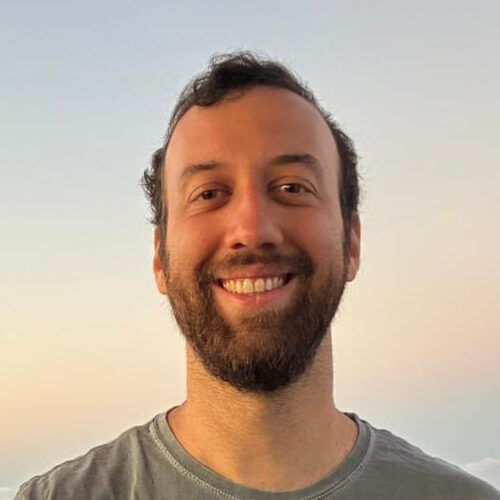
Lower right: Rabbi Adrian Gottfried and his son, Eitan Gottfried (me).
For readers interested in exploring Rabbi Marshall Meyer’s life, work, and intellectual legacy in greater depth, the following resources offer valuable perspectives:
• Duke University Libraries – “Marshall T. Meyer Collection”
A rich archive of documents, correspondence, photographs, and materials related to Rabbi Meyer’s activism, rabbinic leadership, and work during Argentina’s military dictatorship.
https://repository.duke.edu/dc/meyermarshall
• Duke University Libraries Digital Exhibit – “I Have No Right to Be Silent: The Legacy of Rabbi Marshall T. Meyer”
A curated online exhibit highlighting key moments of Rabbi Meyer’s life, including his human rights work, founding of the Seminario Rabínico Latinoamericano, and influence at B’nai Jeshurun.
https://exhibits.library.duke.edu/exhibits/show/ihavenorighttobesilent/rememberingmarshall
• Fainstein, Daniel. Judaísmo, Direitos Humanos e Espiritualidade: Uma Biografia Intelectual do Rabino Marshall T. Meyer (Comunidade Shalom, 2013)
A comprehensive intellectual biography that examines Rabbi Meyer’s theological development and commitments to human rights.
https://www.amazon.com.br/Juda%C3%ADsmo-Direitos-Humanos-Espiritualidade-Intelectual/dp/8560808019
• Fainstein, Daniel. “Secularización, Profecía y Liberación: La desprivatización de la religión en el pensamiento judío contemporáneo”
A doctoral study analyzing Rabbi Meyer’s contribution to contemporary Jewish public life, exploring themes of prophecy, liberation, and social engagement. (See Chapter 4.)
https://ru.dgb.unam.mx/server/api/core/bitstreams/8322011c-2ab7-4cb7-8ea5-aa1dd4c7373d/content