
My father, Irwin, lost his own father, Stanley, when he was just 11 years old. Even now, at 62, the loss is still painful—especially now, as a new grandfather. My first child, Billie, was born in 2022. His father never got to meet his own grandchildren.
My Dad remembers his childhood as a simpler time. You’d go out on your bike, with no helmet, and as long as you were back by a certain time, you were okay.
It was clear what mattered to his parents. “During that time I had with him [my father], being Jewish was important to him. He would pick out certain seats during the High Holidays to lean on the wall facing Jerusalem. I just remember growing up around a lot of Jewish people, in elementary school, our neighborhood, my friends,” he said. “It was important for my father and mother that we visited Israel, it was his dream. My mother fulfilled his dream.”
My Dad’s mother, Lois, seemed to often be a dream fulfiller, seeing out tightly held hopes and wishes of her family, throughout her life. And that’s where this story lives—with our matriarch.
Lois’ father would describe himself as a religious man, keeping kosher, and hosting each holiday with his 12 siblings. Being Jewish was important to him, especially living in a non-Jewish neighborhood in suburban Baltimore. It was even more important to make sure that Lois got to experience “Jewishness.” It was a dream of his that his daughters learn and live Jewishly, so they sent her to a Jewish nursery school, driving out of the neighborhood to ensure she was present each day.
“There was a Catholic church across the street from my father’s store growing up. In fact, I still remember the name of the priest, Father Dunn. He knew Hebrew. He would come into the store and talk religion with my father,” she told me. On reflection, those interactions were foundational to her “open tent” Judaism and Jewish pride. (This is a reference to Abraham and Sarah’s tent where all were welcomed and embraced. Their tent was open on all sides.)
She went to Hebrew school, and was one of two girls in a class of boys. This was in the 1940s, a time where access to Jewish education and TorahRefers to the first five books of the Hebrew Bible, the Tanakh, also called the Five Books of Moses, Pentateuch or the Hebrew equivalent, Humash. This is also called the Written Torah. The term may also refer to teachings that expound on Jewish tradition. Read more wasn’t always given to girls. At age 7 she began her Hebrew studies, which led to her bat mitzvah, a celebration of years of studies at synagogue and at home. A dream of her father’s, fulfilled.
“I still often see the other girl from my Hebrew School these days. We joke that we were in Hebrew School together and reminisce about the timed Hebrew tests,” she said. “I still remember my teacher and his watch.”
Since Lois didn’t live in the Jewish neighborhood, when she attended Baltimore Hebrew High School to continue her Jewish education after her bat mitzvah, the school would send a taxi cab to pick her up. It was clear that this was a pivotal moment in her Jewish education and where her Jewish pride solidified. This was important—a must—for her, for her family.
She would later go to college—at a time when women often faced resistance in higher education—and later earned a master’s degree while raising three children. She met my grandfather Stanley, built a Jewish home, and raised a family rooted in learning.
When Stanley was sick and passed away, Lois was determined that no one would look at the family sadly, saying, “Those poor Golob children.”
She said, “They’re going to do their best, they’re going to make something of themselves, they’re going to be mensches.”
My father replied, “Mom, you kept us together. Just grit and determination. Done with grace.”
Irwin went to Hebrew school, then on to confirmation. Life revolved around being Jewish both at the synagogue and at home.
Irwin was an active member and leader of his local chatper of BBYO (B’nai Brith Youth Organization). “My mother pushed me to do Jewish youth group. She knew I needed it,” he reflected. “The majority of my friends today, I’ve known since I was 14 years old. I learned how to be a leader—that was foundational.”
His Jewish pride came from every direction: from his mother, his father, and from his stepfather Harold, whom Lois married when my Dad was a teen. The blending of these families was so heartwarming. Two families, with different histories, coming together because of a common bond, Jewish values. It was seamless, according to Lois. There was even a point where Harold’s mother, Rose, would pick up Stanley’s mother, Rita, each Shabbat to go to shul.
My Dad would go on to meet my Mother in the first week of college, pursue an advanced degree, and raise two children, both of whom work in the Jewish world. Their “experiment” with kashrut, which was supposed to last for 6 months, is now in its 26th year. My grandmother’s dream, fulfilled.
“It’s important to love your Jewish identity. I hope I did bring that Jewish love and pride to my children and grandchildren,” Lois said.
A father sends his daughter to Jewish nursery school. Their family welcomes their neighbors to join them at their table for Jewish holidays. They believe in the value of humanity, to treat each other well and give the benefit of the doubt. Being a mensch is at the core of all they do.
The story of my grandmother echoes the story of my daughter, Billie—4 generations apart. One born in 1938, the other in 2022.
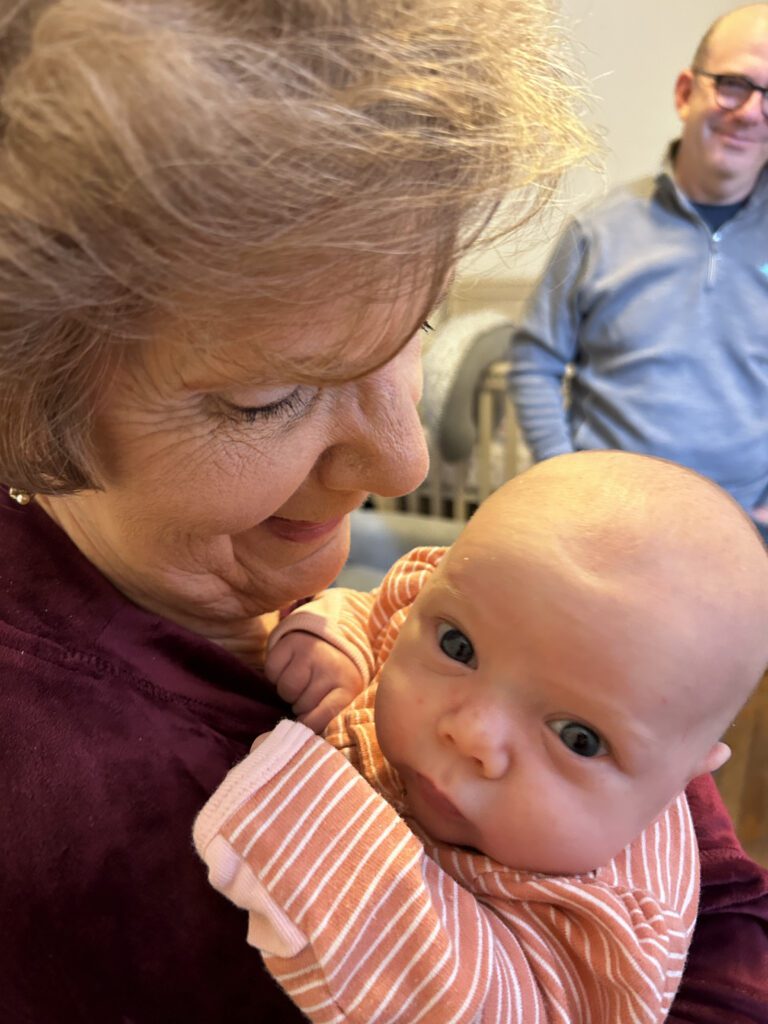
Billie is the third great-grandchild of Lois, the first and only great-granddaughter. In the first weeks of my daughter’s life, Lois, now assuming the name of Gigi, visited my new, growing family on the Upper East Side of New York City. To see my grandmother’s face when she held her great-granddaughter in her arms for the first time—it was magical. Honestly, I couldn’t see much, since my eyes quickly teared up.
I have no doubt that people would call me a somewhat religious man. I’ve worked in the Jewish community for over a decade. I keep a kosher apartment. We often host friends and family for Shabbat dinners and holidays. Being Jewish is important to me—very important—it always has been. It was even more important to make sure that Billie gets to experience “Jewishness” in her own meaningful and authentic way. That is my dream. Each morning, I take Billie on the downtown 6 train to bring her to a Jewish nursery school, to ensure she is present each day.
“I like being Jewish,” said my daughter. “I love my Gigi.”
This essay was submitted as part of Exploring Judaism’s L’Dor V’Dor Essay Contest. To learn more, or submit your own essay, go here.